
Please Note: This article is written for users of the following Microsoft Excel versions: 2007, 2010, and 2013. If you are using an earlier version (Excel 2003 or earlier), this tip may not work for you. For a version of this tip written specifically for earlier versions of Excel, click here: Static Sizes for Comment Boxes.
Jean-Marc is having a problem with comment boxes in his workbooks. It seems that every time he opens an Excel workbook in which he previously inserted comments, those comments have changed size. For example, if he inserts a 2" by 2" comment (or places a picture inside a comment box), the next time he opens the workbook only half the picture shows in a much larger comment box. Jean-Marc is wondering if there is a way to make the comment boxes retain the same size as he originally sets them.
The solution seems to be related to how the comment is created. How you view comments is controlled by three option buttons in the Display group of the Advanced option of the Excel Options dialog box. If you choose to view Comments & Indicators, then the sizes of your comments should remain static. If you choose to view only the indicators, then Excel chooses how and where to display the comment each time it is redisplayed.
If you don't want your comments to always be visible, but you still want them to retain their sizes, then the only option is to develop a macro that will do the resizing for you.
ExcelTips is your source for cost-effective Microsoft Excel training. This tip (9424) applies to Microsoft Excel 2007, 2010, and 2013. You can find a version of this tip for the older menu interface of Excel here: Static Sizes for Comment Boxes.

Professional Development Guidance! Four world-class developers offer start-to-finish guidance for building powerful, robust, and secure applications with Excel. The authors show how to consistently make the right design decisions and make the most of Excel's powerful features. Check out Professional Excel Development today!
Have you ever chosen to edit a comment, only to find that the comment is quite a ways from the cell with which it is ...
Discover MoreIn Excel, single comments are associated with single cells. If you want to have a comment be linked to multiple cells, ...
Discover MoreExcel won't allow you to directly or automatically insert the results of a formula into a cell's comment. You can, ...
Discover MoreFREE SERVICE: Get tips like this every week in ExcelTips, a free productivity newsletter. Enter your address and click "Subscribe."
2025-11-18 18:44:17
Tomek
Gonzonator1982:
Thank you for your reply. I did not know that and there is no mention of this in the Microsoft help for the HYPERLINK function in Excel.
So I learned something new. And I thought I knew Excel - I have been using it for about 30 years.
2025-11-18 12:21:15
Gonzonator1982
Tomek, the Hash "#" tells the hyperlink formula to look inside the document for the hyperlink; without it, the hyperlink looks out to the web by default.
2025-11-16 16:35:44
Tomek
As I mentioned in my earlier comment, both the solution from Allen's tip, and my alternate macro-based approach may not properly display the requested report. If the range covering a particular report is away from left and/or top of the sheet, selecting the cell/range may display it far to the right/down with large portion of it hidden outside the visible part of the sheet. To avoid this, for the hyperlink solution, you can add a simple macro to each target sheet code:
Private Sub Worksheet_Activate()
Application.Goto Selection, Scroll:=True
End Sub
When the hyperlink is clicked, it will select the desired range on the target. Upon activating the target sheet, the screen will scroll to display the active cell in the top corner. And yes, you can pass a range of cells via hyperlink, not only a single cell. (see Figure 1 below) The limitation of this is that the report cannot be on the same sheet as the hyperlink, as this sheet is already active.
For the macro solution a slight modification will do the same. To make it more user friendly, I added the second window, in which the report will be displayed. So you will have two windows for the same file, one for the Table of Contents, and one for the report. Closing the second window after report is reviewed/printed will simply get you back to the Table of Contents.
As I said in my earlier comment, the macro approach saves you some clicks - only two are required for selecting from the drop-down list vs. four for the hyperlink approach. As I always say, there are many ways to skin a catfish (not a cat - I love cats), but some are better than others.
=========
Private Sub Worksheet_Change(ByVal Target As Range)
If Not Intersect(Target, Range("F1")) Is Nothing Then
ActiveWindow.NewWindow
sht = Range("G1").Value
cel = Range("H1").Value
Sheets(sht).Activate
ActiveSheet.Range(cel).Select
Application.Goto , True
End If
End Sub
====================
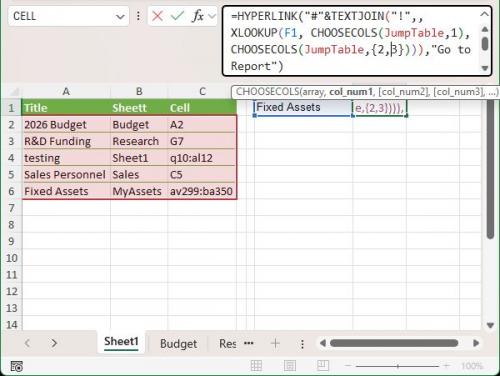
Figure 1.
2025-11-16 11:22:01
Tomek
@Peter
Your formula does not work
2025-11-16 00:55:36
Peter
I have used a jump table similar to this just using a macro, but found that if the target worksheet was edited the target cell often moved. To avoid ending up in the wrong cell, taking the last row of the example, I would refer to the target cell with the following formula in column C
=CELL("address",'My Assets'W15).
2025-11-15 23:03:14
Tomek
Further to my earlier comment:
You may not need to go to a specific target cell, just activate the sheet with the requested report.
In such case you can omit the entry in the cell H1, as well as two lines of the code making it simpler:
Private Sub Worksheet_Change(ByVal Target As Range)
If Not Intersect(Target, Range("F1")) Is Nothing Then
sht = Range("G1").Value
Sheets(sht).Activate
End If
End Sub
=================
In any case you may want to make sure that the relevant area of sheet that opens is properly positioned in the Excel Window; just selecting a particular cell does not necessarily position it in the upper left corner of the window. This applies also to the hyperlink method. How to get the proper view of the sheet with the report when it opens is a whole different story, and may be a subject of a future tip, if Allen agrees.
2025-11-15 22:43:38
Tomek
The method proposed in the tip works well and is exactly what Mark asked for, but it requires four or three clicks: select the cell with the multiple choice (unless already selected), click on the down arrow, select one of options from the drop-down list, then click the hyperlink in another cell. I think the last click is not necessary, hence the use of the hyperlink is also not necessary. On the other hand, my suggestion is to use a macro that some users may not not like or even be able to do (company policies).
I suggest the macro be triggered by a change in the cell with the drop-down list.
The setup is the same as in the tip, up to the point where the validation list is created in the cell F1.
Instead of creating a hyperlink in a nearby cell, use VLOOKUP based on JumpTable to get the sheet name and the target cell into the neighbouring cells G1 and H1, respectively:
=VLOOKUP(F1,JumpTable,2,FALSE)
=VLOOKUP(F1,JumpTable,3,FALSE)
(see Figure 1 below)
You could also use XLOOKUP for this purpose. Please note that for simplicity I made sure that sheet names have no spaces.
Once you have all this in place add the following macro to your "Table of Contents" sheet code:
Private Sub Worksheet_Change(ByVal Target As Range)
If Not Intersect(Target, Range("F1")) Is Nothing Then
sht = Range("G1").Value
cel = Range("H1").Value
Sheets(sht).Activate
ActiveSheet.Range(cel).Select
End If
End Sub
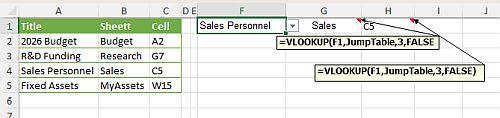
Figure 1.
2025-11-15 16:39:21
Tomek
What is the purpose of the "#" in the formula:
=HYPERLINK("#"&TEXTJOIN("!",, XLOOKUP(F1, CHOOSECOLS(JumpTable,1), CHOOSECOLS(JumpTable,{2,3}))),"Go to Report")
I know it is important, because it does not work without it, but I have no idea why.
Got a version of Excel that uses the ribbon interface (Excel 2007 or later)? This site is for you! If you use an earlier version of Excel, visit our ExcelTips site focusing on the menu interface.
FREE SERVICE: Get tips like this every week in ExcelTips, a free productivity newsletter. Enter your address and click "Subscribe."
Copyright © 2025 Sharon Parq Associates, Inc.
 Please Note:
This article is written for users of the following Microsoft Excel versions: 2007, 2010, and 2013. If you are using an earlier version (Excel 2003 or earlier), this tip may not work for you. For a version of this tip written specifically for earlier versions of Excel, click here:
Please Note:
This article is written for users of the following Microsoft Excel versions: 2007, 2010, and 2013. If you are using an earlier version (Excel 2003 or earlier), this tip may not work for you. For a version of this tip written specifically for earlier versions of Excel, click here: 
Comments