
Please Note: This article is written for users of the following Microsoft Excel versions: 2007, 2010, 2013, 2016, 2019, 2021, and Excel in Microsoft 365. If you are using an earlier version (Excel 2003 or earlier), this tip may not work for you. For a version of this tip written specifically for earlier versions of Excel, click here: Copying to Very Large Ranges.
Chris wonders if there is a fast way to copy a cell to a very large range. He knows how to use the mouse to scroll in order to select the target range, but if he's copying to thousands (or tens of thousands) of cells, it takes an awfully long time to scroll through screen after screen.
Using the mouse to select large ranges of cells is cumbersome, at best. There are much easier ways to select large ranges, and these selection methods can be used to easily copy values to those large ranges.
Let's say that you have a value in cell A3 and you want to copy it to a large range, such as C3:C99999. The easiest way to do the copy is to follow these steps:
Easy, huh? A similar approach to selecting large ranges could also be used with the Go To box, in this manner:
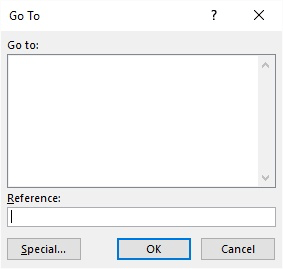
Figure 1. The Go To dialog box.
If you ever find yourself needing to copy to very large ranges using a macro, you can do so using a single command. To copy only the value from A3 to the range C3:C99999, you would use the following:
Range("C3:C99999") = Range("A3").Value
If you instead wanted to copy both values and formats to the large range, then you could use this command:
Range("A3").Copy Destination:=Range("C3:C99999")
Regardless of how you perform your copying task, make sure you are patient. Depending on what you are copying, it can take quite a while for the operation to complete. If you are copying a formula to such a large range, then it can take very long as Excel performs the thousands of new calculations you've required of it.
Note:
ExcelTips is your source for cost-effective Microsoft Excel training. This tip (12449) applies to Microsoft Excel 2007, 2010, 2013, 2016, 2019, 2021, and Excel in Microsoft 365. You can find a version of this tip for the older menu interface of Excel here: Copying to Very Large Ranges.
Best-Selling VBA Tutorial for Beginners Take your Excel knowledge to the next level. With a little background in VBA programming, you can go well beyond basic spreadsheets and functions. Use macros to reduce errors, save time, and integrate with other Microsoft applications. Fully updated for the latest version of Office 365. Check out Microsoft 365 Excel VBA Programming For Dummies today!
Deleting unwanted links in a workbook can be a challenge, particularly if you are not sure how those links got there. ...
Discover MoreWouldn't it be great if you could have Excel display some text in a cell only when that cell is empty? Unfortuantely, ...
Discover MoreIf you copy a cell that contains a reference to external data, do you get an error? It could be due to the complexity of ...
Discover MoreFREE SERVICE: Get tips like this every week in ExcelTips, a free productivity newsletter. Enter your address and click "Subscribe."
There are currently no comments for this tip. (Be the first to leave your comment—just use the simple form above!)
Got a version of Excel that uses the ribbon interface (Excel 2007 or later)? This site is for you! If you use an earlier version of Excel, visit our ExcelTips site focusing on the menu interface.
FREE SERVICE: Get tips like this every week in ExcelTips, a free productivity newsletter. Enter your address and click "Subscribe."
Copyright © 2026 Sharon Parq Associates, Inc.
 Please Note:
This article is written for users of the following Microsoft Excel versions: 2007, 2010, 2013, 2016, 2019, 2021, and Excel in Microsoft 365. If you are using an earlier version (Excel 2003 or earlier), this tip may not work for you. For a version of this tip written specifically for earlier versions of Excel, click here:
Please Note:
This article is written for users of the following Microsoft Excel versions: 2007, 2010, 2013, 2016, 2019, 2021, and Excel in Microsoft 365. If you are using an earlier version (Excel 2003 or earlier), this tip may not work for you. For a version of this tip written specifically for earlier versions of Excel, click here: 
Comments